Day Book
Record Every Transaction Daily
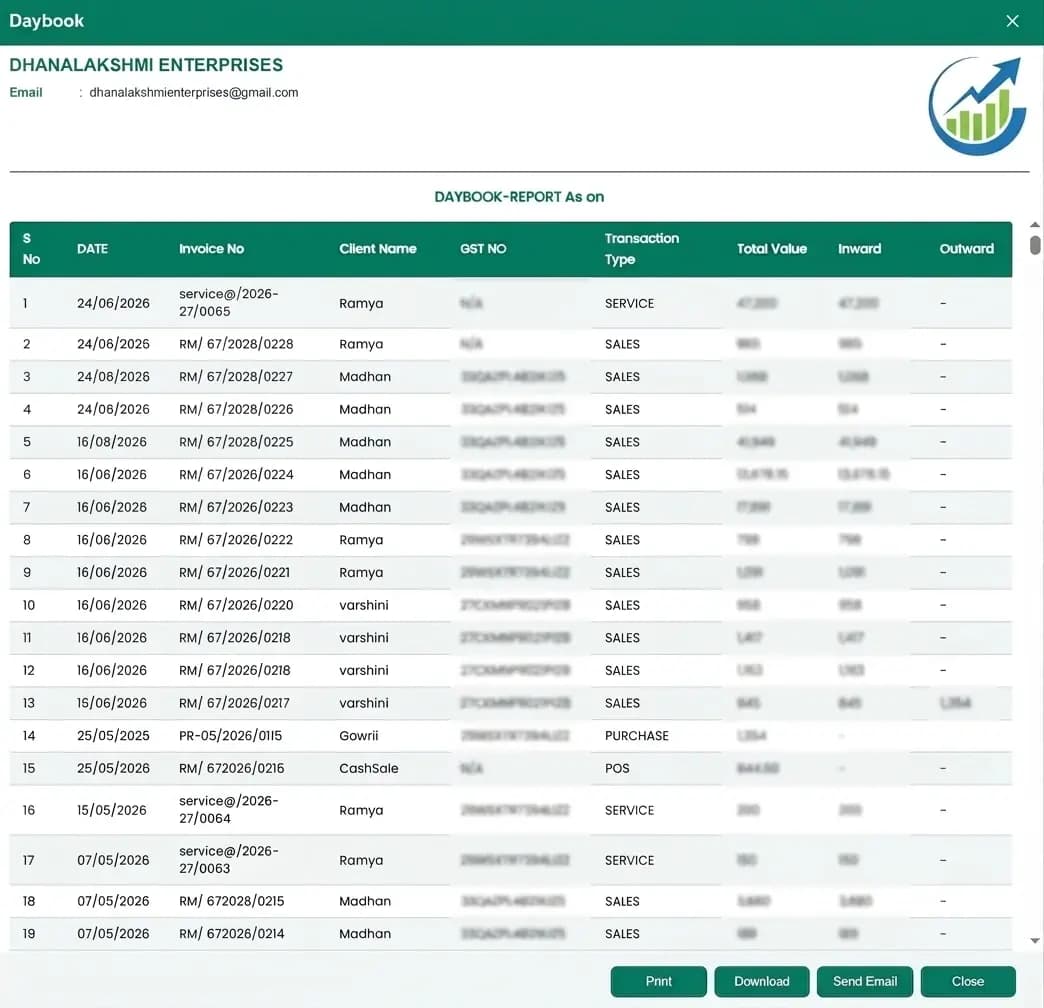
Maintain a complete record of all business transactions in one place. Track receipts, payments, and journal entries with ease. Get real-time insights into your financial activities and maintain accurate books.
Daily Entries
All transactions
Real-time Balance
Auto-calculated
Fast Search
Quick lookup
Data Security
Bank-grade
Everything You Need to Manage Day Book Efficiently
Day Book Entry
Record all daily transactions in one place.
Ledger Management
Maintain complete ledger accounts for all parties.
Receipt & Payment
Track all receipts and payments effortlessly.
Date-wise Reports
View transactions by day, month, or year.
Print Reports
Generate printable day book reports.
Complete Day Book Report Guide
A Day Book Report is a chronological record of all financial transactions that occur in your business on a daily basis. It serves as the primary entry point for all transactions before they are classified and posted to the general ledger. This comprehensive report captures every sale, purchase, receipt, and payment, providing a complete audit trail of your business's financial activities.
Day Book Reports are essential for maintaining accurate financial records, tracking daily cash flow, and ensuring that all transactions are properly documented. Modern day book software automates this process, reducing manual errors and providing real-time visibility into your business's financial health.
Key Components of a Day Book Report
Transaction Date & Time
Every entry includes the exact date and time of the transaction, creating a clear chronological sequence of all financial activities.
Transaction Reference Number
Unique identifier for each transaction, making it easy to track, reference, and reconcile entries with supporting documentation.
Account Details
Information about the accounts involved, including account names, numbers, and types, ensuring proper classification.
Transaction Description
Clear narrative describing the nature of the transaction, including parties involved and purpose of the transaction.
Debit & Credit Amounts
The monetary value of each transaction with clear debit and credit entries, maintaining the double-entry accounting principle.
Transaction Category
Classification of transactions into categories like sales, purchases, expenses, income, or transfers for better analysis.
Why Your Business Needs a Day Book Report
A Day Book Report is fundamental to maintaining accurate financial records and ensuring business success:
- Complete Audit Trail: Every transaction is recorded chronologically, creating an unbroken chain of financial activities.
- Error Detection: Easy identification and correction of discrepancies before they affect financial statements.
- Transaction Verification: Cross-check entries against source documents to ensure accuracy and legitimacy.
- Compliance Support: Maintain proper records for tax authorities and regulatory requirements.
- Financial Analysis: Analyze daily transactions to identify trends, patterns, and areas for improvement.
- Cash Flow Monitoring: Track daily cash movements to maintain healthy liquidity levels.
- Reconciliation Base: Provides the foundation for bank reconciliation and account verification.
- Decision Making: Access to detailed transaction data for informed business decisions.
Key Benefits of Using Day Book Software
Automated Transaction Recording
Day book software automatically captures and records transactions, eliminating manual data entry errors and saving valuable time.
Real-Time Financial Visibility
Access up-to-the-minute transaction data to make informed decisions and respond quickly to changing financial conditions.
Streamlined Reconciliation
Simplify the reconciliation process with organized transaction records that make it easy to match entries with bank statements.
Enhanced Accuracy
Reduce human errors with automated validation rules, ensuring all transactions meet accounting standards and compliance requirements.
Better Audit Preparation
Maintain organized, easily accessible records that streamline audit processes and demonstrate financial transparency.
Improved Cash Flow Management
Monitor daily cash movements and identify potential issues early, maintaining healthy liquidity for business operations.
Best Practices for Maintaining Accurate Day Book Reports
Record Transactions Daily
Enter all transactions on the same day they occur to maintain accuracy and prevent backlog accumulation.
Support with Documentation
Attach supporting documents like receipts, invoices, and contracts to each entry for verification.
Regular Reconciliation
Reconcile day book entries with bank statements weekly to identify and resolve discrepancies quickly.
Implement Approval Workflows
Establish approval processes for transactions to ensure proper authorization and control.
Maintain Backup Copies
Keep secure backup copies of your day book data to prevent loss and ensure business continuity.
Regular Review and Analysis
Review day book reports regularly to identify trends, monitor performance, and make informed decisions.
Start Using Day Book Software Today
A well-maintained Day Book Report is the foundation of accurate financial records and informed business decisions. With modern day book software, you can automate transaction recording, maintain complete audit trails, and gain real-time visibility into your financial operations. Start implementing these best practices today to streamline your financial managementand drive business growth.
Understanding Day Book Reports for Business Growth
A Day Book Report serves as the primary record of all financial transactions in your business, capturing every sale, purchase, receipt, and payment in chronological order. This comprehensive document provides a complete audit trail of your business activities, forming the foundation for accurate financial reporting and analysis. With modern day book software, businesses can automate this process, ensuring real-time accuracy and enabling better financial management.
01. The Role of Day Book in Financial Management
The Day Book Report is the first step in the accounting cycle, capturing all transactions before they are classified and posted to the general ledger. It serves as a chronological journal of all financial activities, providing a complete record of every transaction. This systematic approach ensures that no transaction is overlooked and maintains the integrity of your financial records, making it easier to track cash flow, identify errors, and prepare accurate financial statements.
02. How Day Book Software Simplifies Record Keeping
Modern day book software automates the recording of transactions, eliminating manual data entry and reducing errors. These solutions integrate with payment systems, bank accounts, and other financial tools to automatically capture transaction data. Features like automatic categorization, real-time updates, and comprehensive reporting provide businesses with instant access to accurate financial information, saving time and improving efficiency.
03. Day Book Reports for Financial Analysis
Day Book Reports provide rich data for financial analysis, enabling businesses to identify patterns, track spending trends, and monitor revenue streams. By analyzing daily transaction data, you can gain insights into customer behavior, seasonal fluctuations, and operational efficiency. This analysis helps in making informed decisions about pricing, inventory management, and resource allocation, driving business growth and profitability.
04. Day Book for Compliance and Auditing
Maintaining a detailed Day Book Report is essential for regulatory compliance and audit readiness. These reports provide a clear audit trail that demonstrates financial transparency and accountability. With organized transaction records, you can quickly respond to auditor inquiries, provide supporting documentation, and ensure compliance with tax regulations and accounting standards.
05. Leveraging Day Book Data for Strategic Decisions
The data captured in Day Book Reports is a valuable asset for strategic decision-making. By analyzing transaction patterns, you can identify opportunities for cost reduction, revenue enhancement, and operational improvement. Whether you're planning for expansion, evaluating new products, or optimizing cash flow, access to detailed transaction data empowers you to make decisions based on facts rather than assumptions.
✓ A well-maintained Day Book Report is essential for financial accuracy, regulatory compliance, and informed decision-making, providing the foundation for sustainable business growth.